

In the temple corridors, mountain paths, and even street corners of bustling cities on the snowy plateau, the prayer wheel has always been a unique and sacred scenic line. Countless believers fold their hands together, lightly pushing the sutra tube with their fingertips, and in a clockwise rotation, integrate their faith, prayers, and spiritual sustenance into every cycle of reincarnation. Behind this seemingly simple action lies the profound cultural and spiritual code of Tibetan Buddhism.
1、 Clockwise: Concrete expression of cosmic rhythm
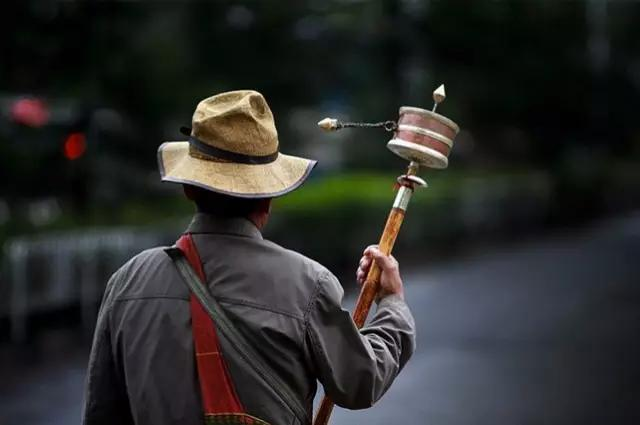
In the cosmology of Tibetan Buddhism, clockwise direction is regarded as the natural flow trajectory of cosmic energy, similar to the direction of the sun rising in the east and setting in the west, and the movement of stars. When rotating the prayer wheel clockwise, it not only echoes the order of the universe, but also symbolizes the promotion of Buddhism and the infinite extension of wisdom. Believers believe that when the scripture tube rotates in this direction, the scriptures and mantras inside will release auspicious energy along the flow trajectory, accumulating merit for themselves and sentient beings, bringing peace, prosperity, and happiness. Every clockwise push is a spiritual dialogue with the Buddha, a devout tribute to the wisdom of Buddhism.
2、 The prayer wheel: the crystallization of craftsmanship and faith
The prayer wheel is not an ordinary object, and its structure and material are full of craftsmanship and sacredness. Traditional prayer wheels are often made of metal, wood, or stone and are cylindrical in shape, with exquisite Buddhist scriptures or mantras carved on the top. Inside the tube, there are densely packed scrolls or wooden strips engraved with scriptures. As the tube rotates, the scrolls slowly unfold, resembling a silent chanting ceremony. This process is not only the promotion of Buddhism, but also a spiritual inheritance that transcends time and space, helping practitioners to focus on prayer and meditation while rotating, and to settle their hearts.
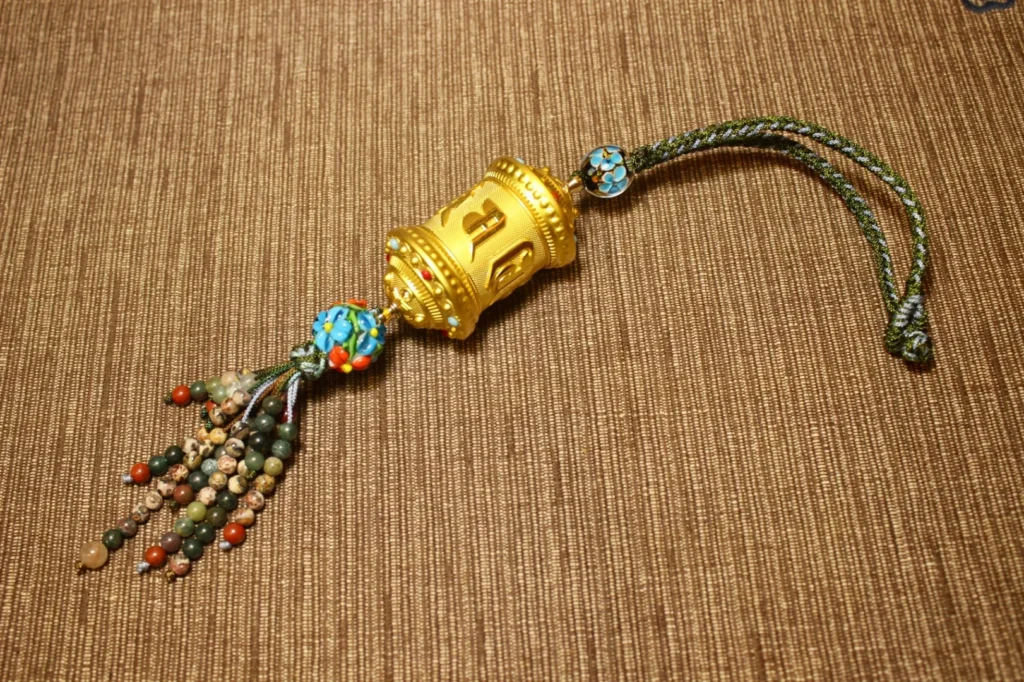
Nowadays, the sacred meaning of the prayer wheel has also been integrated into modern jewelry design, such as the six character prayer wheel ring. The outer ring of the ring is engraved with the sacred six character mantra of “Om Mani Beimei”. The wearer can gently rotate the ring to feel piety and tranquility anytime and anywhere, allowing ancient spiritual wisdom to be rejuvenated in daily life.
3、 The diverse forms of prayer wheels and sacred fields
The shape of the prayer tube is diverse, ranging from portable handheld prayer tubes to towering giant prayer tubes in temples, each emitting a mysterious and solemn aura. In Tibetan Buddhist temples, one can often see neatly arranged arrays of huge prayer wheels, some relying on mechanical devices to continuously rotate, while others wait for believers to push them by themselves. Regardless of their form, they are concrete expressions of faith and indispensable spiritual totems in Tibetan culture.
The believers walked slowly around the scripture tube, with their fingertips lightly touching and silently reciting the scriptures in their mouths. In one circle after another, they integrated their inner prayers into the flowing time. These sutras are like silent guardians, witnessing the piety and hope of countless people, and creating a sacred atmosphere that can instantly calm the soul.
4、 Clockwise rotation: an important principle on the path of cultivation
In the practice system of Tibetan Buddhism, the prayer wheel holds an important position, especially in the Nyingma school. The Ningma School emphasizes the practice of the Great Perfection, influenced by the culture of Bon, and has a unique understanding of life and death. They worship the Silent Lord and the Wrath Lord, also known as the “Middle Yin Hundred Masters,” hoping to clear their karmic obstacles in this life and accumulate blessings for the next life. Turning the prayer wheel clockwise is the key way for them to pray for blessings in the afterlife.
It should be noted that clockwise rotation is the core principle for the use of prayer wheels. If it rotates counterclockwise, in traditional beliefs, it may interfere with the practitioner’s reincarnation. Therefore, for those who are not yet familiar with the correct rotation method, out of respect for their faith, if unsure, they may first pause and observe. Because in this sacred ceremony, every action carries profound meaning and cannot be treated arbitrarily.
5、 World’s Greatest: The Shocking and Devout of the Giant Sutra Drum at Nyima Temple
The giant prayer wheel located at Niangma Temple in Maqu County, Gannan Tibetan Autonomous Prefecture, Gansu Province, China, can be regarded as a magnificent monument of Tibetan Buddhist culture. This sutra tube is 37 meters high, with a lower tube diameter of 12 meters and an upper tube diameter of 17 meters. It weighs a total of 320 tons and stands tall with a magnificent momentum.
The interior of the scripture tube is filled with sacred scriptures, and every rotation is a large-scale ‘chanting’, accumulating immeasurable merit. The twelve zodiac animal patterns carved externally are infused with profound Tibetan cultural heritage. Believers will tie the symbol of blessings, Hada, to the corresponding zodiac sign, and then push the sutra tube clockwise, devoutly reciting sutras and making wishes. This series of rituals is not only a tribute to religious beliefs, but also an inheritance and protection of Tibetan traditional culture.
From the small handheld prayer tube to the awe inspiring giant prayer wheel, the clockwise rotation never stops. It is not only a symbol of Tibetan Buddhist faith, but also carries a thousand years of cultural accumulation and spiritual pursuit. Every rotation is a purification of the soul, a deep dialogue with faith. For everyone who approaches the prayer wheel, respecting its direction of rotation and the cultural connotations behind it is the only way to truly appreciate the sanctity and tranquility from the snowy plateau.